Browsers are
difficult
Please wait, loading your map...
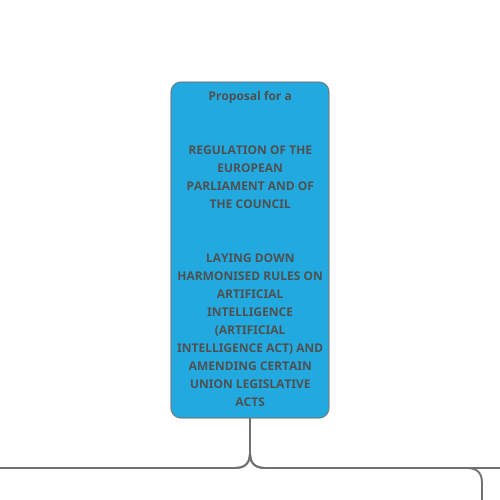
Proposal for a
REGULATION OF THE
EUROPEAN
PARLIAMENT AND OF
THE COUNCIL
LAYING DOWN
HARMONISED RULES ON
ARTIFICIAL
INTELLIGENCE
(ARTIFICIAL
INTELLIGENCE ACT) AND
AMENDING CERTAIN
UNION LEGISLATIVE
ACTS
EXPLANATORY
MEMORANDUM
1. CONTEXT OF THE
PROPOSAL
2. LEGAL BASIS,
SUBSIDIARITY AND
PROPORTIONALITY
3.
RESULTS OF EX-POST
EVALUATIONS,
STAKEHOLDER
CONSULTATIONS AND
IMPACT ASSESSMENTS
4. BUDGETARY
IMPLICATIONS
5. OTHER ELEMENTS
LEGISLATIVE FINANCIAL
STATEMENT
Regulatory Proposal
Acting in accordance
with the ordinary
legislative procedure,
Whereas: (89
paragraphs) HAVE
ADOPTED THIS
REGULATION:
TITLE I GENERAL
PROVISIONS (articles
1-4)
TITLE II PROHIBITED
ARTIFICIAL
INTELLIGENCE
PRACTICES (article 5)
1. The following
artificial intelligence
practices shall be
prohibited:
a) the placing on the
market, putting into
service or use of an AI
system that deploys
subliminal techniques
beyond a person’s
consciousness in order
to materially distort a
person’s behaviour in a
manner that causes or
is likely to cause that
person or another
person physical or
psychological harm;
b) the placing on the
market, putting into
service or use of an AI
system that exploits
any of the
vulnerabilities of a
specific group of
persons due to their
age, physical or mental
disability, in order to
materially distort the
behaviour of a person
pertaining to that
group in a manner that
causes or is likely to
cause that person or
another person physical
or psychological harm;
c) the placing on the
market, putting into
service or use of AI
systems by public
authorities or on their
behalf for the
evaluation or
classification of the
trustworthiness of
natural persons over a
certain period of time
based on their social
behaviour or known or
predicted personal or
personality
characteristics, with the
social score leading to
either or both of the
following:
i) detrimental or
unfavourable treatment
of certain natural
persons or whole
groups thereof in social
contexts which are
unrelated to the
contexts in which the
data was originally
generated or collected;
ii) detrimental or
unfavourable treatment
of certain natural
persons or whole
groups thereof that is
unjustified or
disproportionate to
their social behaviour
or its gravity;
d) the use of ‘real-time’
remote biometric
identification systems
in publicly accessible
spaces for the purpose
of law enforcement,
unless and in as far as
such use is strictly
necessary for one of the
following objectives:
i) the targeted search
for specific potential
victims of crime,
including missing
children;
ii) the prevention of a
specific, substantial and
imminent threat to the
life or physical safety of
natural persons or of a
terrorist attack;
iii) the detection,
localisation,
identification or
prosecution of a
perpetrator or suspect
of a criminal offence
referred to in Article
2(2) of Council
Framework Decision
2002/584/JHA 62 and
punishable in the
Member State
concerned by a
custodial sentence or a
detention order for a
maximum period of at
least three years, as
determined by the law
of that Member State.
2. The use of ‘real-time’
remote biometric
identification systems
in publicly accessible
spaces for the purpose
of law enforcement for
any of the objectives
referred to in
paragraph 1 point d)
shall take into account
the following elements:
3. As regards
paragraphs 1, point (d)
and 2, each individual
use for the purpose of
law enforcement of a
‘real-time’ remote
biometric identification
system in publicly
accessible spaces shall
be subject to a prior
authorisation granted
by a judicial authority
or by an independent
administrative
authority of the
Member State ...
4. A Member State may
decide to provide for
the possibility to fully
or partially authorise
the use of ‘real-time’
remote biometric
identification systems
in publicly accessible
spaces for the purpose
of law enforcement
within the limits and
under the conditions
listed in paragraphs 1,
point (d), 2 and 3...
TITLE III HIGH-RISK AI
SYSTEMS (articles 6-51)
CHAPTER 1.
CLASSIFICATION OF AI
SYSTEMS AS HIGH-RISK
Article 6. Classification
rules for high-risk AI
systems
Article 7. Amendments
to Annex III
CHAPTER 2.
requirements for high-
risk Ai systems
Article 8. Compliance
with the requirements
Article 9. Risk
management system
Article 10. Data and
data governance
Article 11. Technical
documentation
Article 12. Record-
keeping
Article 13. Transparency
and provision of
information to users
Article 14. Human
oversight
Article 15. Accuracy,
robustness and
cybersecurity
CHAPTER 3.
OBLIGATIONS OF
PROVIDERS AND USERS
OF HIGH-RISK AI
SYSTEMS and other
parties (articles 16-29)
CHAPTER 4. NOTIFIYING
AUTHORITIES AND
NOTIFIED BODIES
(articles 30-39)
CHAPTER 5. STANDARDS,
CONFORMITY
ASSESSMENT,
CERTIFICATES,
REGISTRATION (articles
40-51)
TITLE IV.
TRANSPARENCY
OBLIGATIONS FOR
CERTAIN AI SYSTEMS
(article 52)
TITLE V. MEASURES IN
SUPPORT OF
INNOVATION (articles
53-58)
TITLE VI. GOVERNANCE
(articles 56-59)
TITLE VII. EU DATABASE
FOR STAND-ALONE
HIGH-RISK AI SYSTEMS
(article 60)
TITLE VIII. POST-
MARKET MONITORING,
INFORMATION
SHARING, MARKET
SURVEILLANCE
(articles 61-68)
TITLE IX. CODES OF
CONDUCT (article 69)
TITLE X.
CONFIDENTIALITY AND
PENALTIES (articles
70-72)
TITLE XI. DELEGATION
OF POWER AND
COMMITTEE
PROCEDURE (articles
73-74)
TITLE XII. FINAL
PROVISIONS (articles
75-85)
ANNEXES (I-IX)
×
Created using
MindMup.com