Browsers are
difficult
Please wait, loading your map...
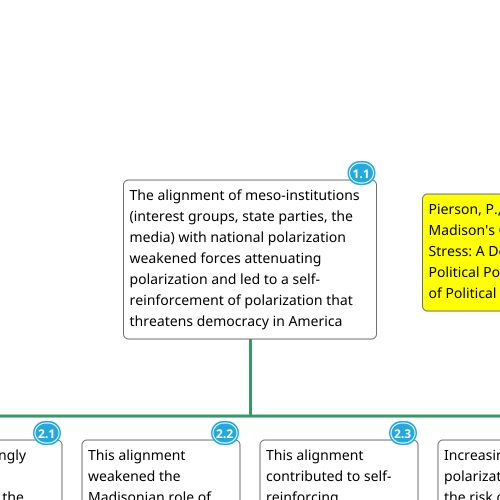
The alignment of meso-institutions
(interest groups, state parties, the
media) with national polarization
weakened forces attenuating
polarization and led to a self-
reinforcement of polarization that
threatens democracy in America
1.1
In an increasingly
polarized
environment, the
meso-institutions
aligned themselves
with the two national
parties over the past
decades
2.1
powerful interest
groups "faced
incentives to pick a
party" (p. 45)
3.1
The parties in the
States have incentives
to integrate
themselves "into
national party
networks" (p. 47)
3.2
Due to primaries,
State parties lost
power in nominating
candidates
4.1
Fundraising has been
nationalized so that
State parties depend
on national parties
for resources
4.2
Voters perceive State
parties as mirroring
"their national
counterparts" (p. 47)
4.3
Based on the
dominance of
national news over
local news and the
growth of an "outrage
industry," the media
have "powerful
incentives to intensify
polarization" (p. 48)
3.3
This alignment
contributed to self-
reinforcing
polarization
2.3
"The deeper and more intense
the partisan divide, the stronger
the incentives for most interest
groups to join a team, and the
more closely aligned groups are
with parties, the stronger the
incentives for them to do all
they can to help their team
win" (p. 45)
3.4
Increasing
polarization increases
the risk of
"democratic
backsliding" (pp.
53-54)
2.4
Evidence for
increasing
polarization is
correlated with
evidence for "gradual
democratic erosion"
in America (p. 53)
3.5
There is evidence that
the GOP is vulnerable
to "bandwagoning,"
"a process in which
disparate elites within
a coalition face
growing incentives to
go along with
extremists or
antidemocratic
practices" (pp. 53-54)
3.6
This alignment
weakened the
Madisonian role of
the meso-institutions
to countervail
polarization
2.2
Pierson, P., & Schickler, E. (2020).
Madison's Constitution Under
Stress: A Developmental Analysis of
Political Polarization. Annual Review
of Political Science, 23, 37-58.
1.2
Hoffmann, M. H. G. (2025).
Pierson and Schickler's
(2020) argument in
"Madison's Constitution
Under Stress: A
Developmental Analysis of
Political
Polarization" (argument
map): URL
1.3
×
Created using
MindMup.com