Browsers are
difficult
Please wait, loading your map...
A
B
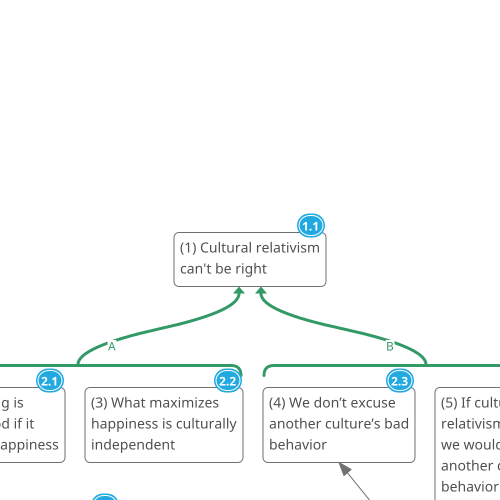
(1) Cultural relativism
can't be right
1.1
(2) Something is
ethically good if it
maximizes happiness
2.1
(3) What maximizes
happiness is culturally
independent
2.2
(4) We don’t excuse
another culture’s bad
behavior
2.3
(5) If cultural
relativism were true,
we would excuse
another culture's bad
behavior
2.4
Premise 4 is probably okay; in fact we do condemn other
cultures for various reasons. One could argue that premise
4 assumes the conclusion since it presupposes that
another culture’s behavior can be bad, but maybe all it
means by “bad” is behavior that we don’t like.
1.4
The first thing I notice about the left-hand branch
of this argument is premise 2. Although it may be
true that something is good it if maximizes
happiness, I don’t think it’s something that we can
expect the argument’s audience to take for
granted. Accordingly, 2 is a bad premise. Perhaps it
could be transformed into a decent subconclusion,
but as it stands, the left line of reasoning is bad.
1.2
The inference is fine
because belief in 4
and 5 would
practically compel
belief in 1.
1.3
Premise 5, however, is a bit confusing. Cultural relativism would allow us to criticize
what another culture does, provided we’re explicit about the fact that we’re leveling that
criticism from the ethical point of view defined by our own culture and are not implying
that this point of view is in any objective sense “better” than the ethical stance defined
by the culture we’re criticizing and according to which that culture’s behavior is perfectly
fine. Of course, that would be a rather weak sort of criticism, but it might be enough to
undercut the claim that cultural relativism would force us to excuse whatever another
culture does. I’m inclined to say, then, that premise 5 is bad, and, in consequence,
maintain that the argument fails as a whole.
1.5
×
Created using
MindMup.com